The red beech & beech wood
The "mother of the forest" - the European beech
The European beech (Fagus sylvatica) (colloquially simply called "beech") is one of the best-known and most important representatives in Europe's forests.
Due to its impressive size and the many important functions it performs in the forest, the beech tree is affectionately called the "Mother of the Forest." Among other things, it ensures the valuable formation of humus and, with its powerful taproots, penetrates the forest floor and provides it with stability.
The dense foliage and the distinctive, smooth bark are also further characteristics of this mighty European deciduous tree.
-
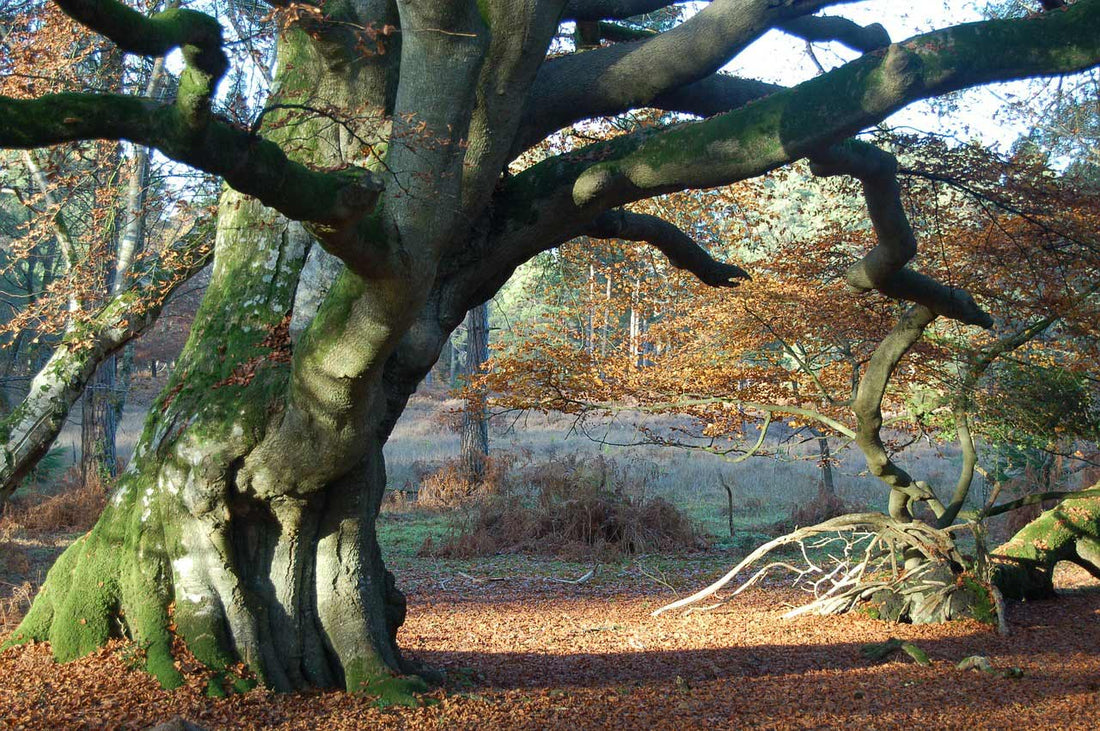
approximately 200 old beech trees

Bark of a European beech

Habit & distribution of the European beech
The European beech is native to almost all of Europe and widespread in many forests. It prefers deep, nutrient-rich soils and is often found in mixed forests. Waterlogged or excessively moist soils, on the other hand, are not suitable locations.
With its characteristic round crown and a height of up to 40 meters, it is often hard to miss and its imposing appearance shapes the local forests. The thick main trunk often splits into two branches, which unfortunately increases the risk of beeches falling victim to serious storm damage.
|
Approximately 200 old beech trees with storm damage

|
View into an autumnal beech forest |

Beech trees, or specific beech varieties, are also becoming increasingly popular in larger gardens and parks. Furthermore, red and copper beeches are also transplanted as hedges.
The copper beech, in particular, is a visual highlight due to its dark red leaf color.
Common beech tree species include:
- European beech
- Copper beech
- Chinese beech
- American beech
- Fern-leaved beech
- Copper beech
- Columnar beech
- various "forms of pendulous growth"
Note: The hornbeam is not related to the beech tree and belongs to the birch family.
Beech trees can reach an age of up to 300 years.
|
Green leaves of the European beech  |
Autumn colors of beech leaves
|

Properties & Uses of Beech Wood
Beechwood is known for its hardness, elasticity, and uniform structure. It is a heavy wood, yet easy to work.
The color varies from a pale pink to a warm, reddish brown. This is also the origin of the name "European beech".
Beechwood is excellent for furniture, parquet flooring and other carpentry work, but is also highly valued as firewood and is also used for smoking.
The typical speckled wood is often seen in various kitchen utensils , cutting boards, or children's toys.
Beech wood is not suitable for outdoor use.
Use of beech wood
- Furniture making, floor coverings: Due to its hardness and durability at a comparatively low price thanks to high availability, beech is probably the most frequently used high-quality wood.
- Wooden kitchen utensils : Because the wood is hard and durable and does not splinter, it is often used for all kinds of kitchen utensils, cutting boards, children's toys, wooden bowls , etc.
- Firewood: Due to its high availability, ease of splitting, and excellent calorific value, beech is a popular firewood.
- Packaging industry: Beech wood is also gaining increasing importance in the packaging industry, plywood, laminated panels, etc.
|
Fruits of the beech tree - beech nuts |
Beech firewood |


My conclusion about the European beech and its wood
The European beech is not only an impressive and important component of our forests, but also a versatile wood.
Nowadays, beech wood is unfortunately often looked down upon - in my opinion, this is often due to its rather calm, almost "boring" grain pattern, but also to the fact that we come into contact with beech wood every day.
Beech wood, however, also offers particularly "wild" color variations and grain patterns, which are then referred to as "heartwood beech." Heartwood beech or wild beech is therefore not a separate "beech species," but simply the term for the wood of the beech tree, which develops quite individually and to varying degrees in the wood and around the heartwood (not in the heartwood itself!) during the tree's lifetime, or not at all.
Beechwood tends to "spalt" quickly when exposed to the elements outdoors. This means the wood is undergoing a decomposition process, being broken down by fungi and developing a particularly decorative discoloration. However, this process also causes the wood to lose its strength and hardness, rendering it unsuitable for further processing and as firewood – except for turners or other woodworkers who stabilize and strengthen spalted beechwood using their own methods and then use it to create high-quality writing instruments , among other things.
Otherwise, the wood is excellent for turning . Wooden products such as wooden bowls , wooden vases , wooden spice mills and the like are often easy to make.
However, due to its hardness, grinding can sometimes be quite time-consuming.
Have I sparked your interest in beechwood? Then take a look at all the products in my online shop. Products made from red beech wood to.
|
Beechwood products |
Wooden wine stoppers made of beech |
|
Wooden bowl made of beech
|
Wooden vase made of red beech |
|
Wooden writing instruments made of beech wood |
Wooden bottle opener made of red beech |


